Content Notice: Please note this article below contains information about childbirth. For some people, childbirth is associated with traumatic memories. If anything conveyed in this article touches a sensitive place for you, please know there are therapeutic support options to heal and process past birth experiences or perinatal loss.
In this article, I will introduce the perinatal matrices from the experience of the baby being born. This will be followed by a discussion about how the perinatal matrices express in our life as adults, from archetypal aspects, to inner psychology, experiences of time, and to the challenges we face in life.
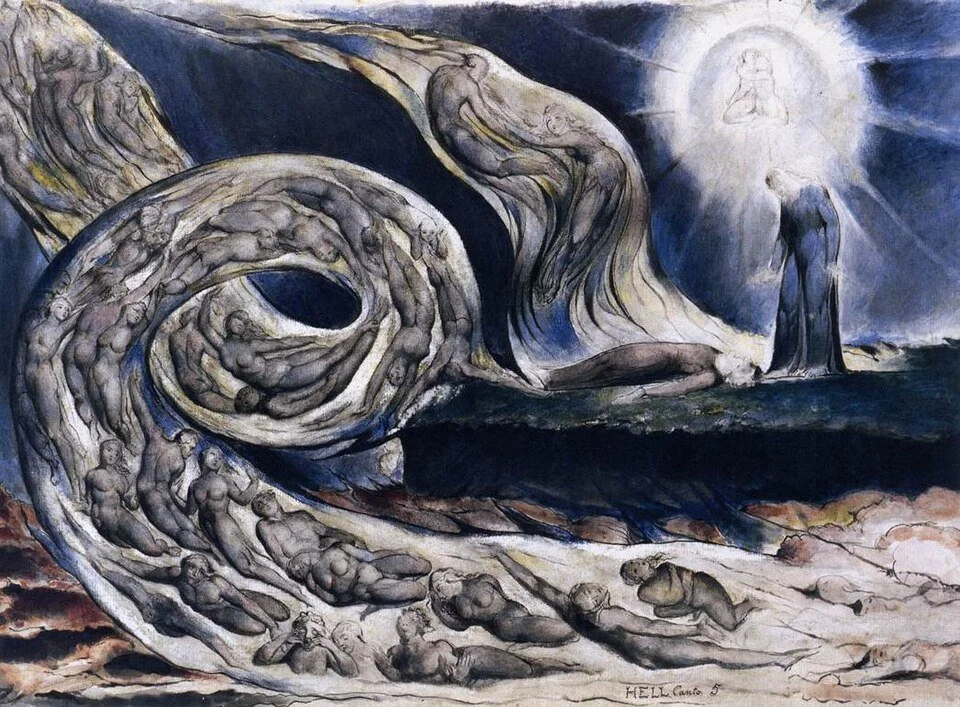
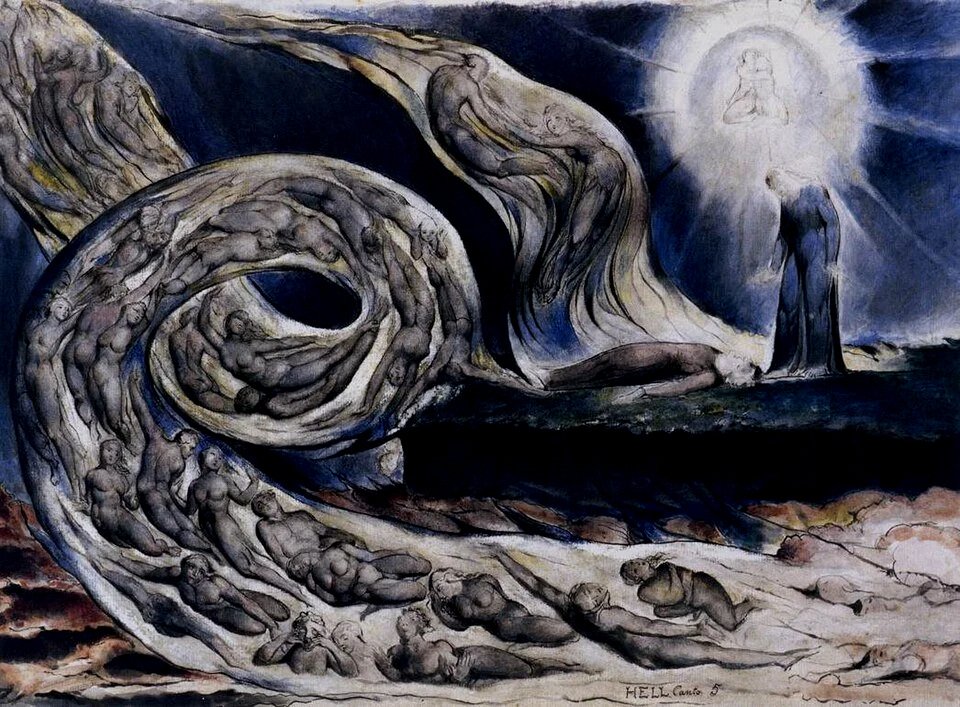
William Blake, The Whirlwind of Lovers, 1827. Public domain, via Wikimedia Commons
The image above is a remarkable painting by William Blake titled “The Whirlwind of Lovers”. This image feels symbolic of the birth journey we take inside our mothers womb and birth canal, spiraling from heaven into earth. A central experience for all of us in life is the journey of love, the foundations of which are shaped by our life in the womb and the spiraling passage of birth we experience with our mother. In life, we continue this journey of arriving in our bodies on earth, and simultaneously we also spiral from earth to heaven in our journey to connect to our spiritual essence.
What are the Perinatal Matrices?
The Perinatal Matrices, also known as Basic Perinatal Matrices (BPM’S), is a conceptual map of the human psyche developed by clinical psychiatrist and researcher Stanislav Grof (Grof, 1975). The Perinatal Matrices correspond to the stages of womb life and the initiatory experiences of labour and birth. The Perinatal Matrices offer orientation in understanding the journey a child takes from the womb, through the birth canal into the world of earth. This unique map of the human psyche sheds light on how our womb life and birth experience are remembered in our body and psyche. Like a hologram, the memories and feelings of our early perinatal life are re-experienced in our body and psyche through the myriad experiences we encounter in life.
There are four basic perinatal matrices (BPM), defined by Stanislav Grof (Grof, 1975):
BPM1 – Primal Union with Mother : symbiosis, merging, diffuse boundaries
BPM2 – Antagonism with Mother : no exit, contractions in closed uterine system
BPM3 – Synergism with Mother : propulsion through the birth canal
BPM4 – Separation from the Mother : termination of symbiotic union and formation of a new type of relationship
BPM 1 - PRIMAL UNION WITH MOTHER
Babies Experience in the Womb Before Labour Onset
We can experience both harmonious and challenging aspects of existence whilst growing in our mothers womb during the 10 months of pregnancy. The harmonious aspects are characterised by feelings of: love, contentment and satisfaction of needs, feelings of being bathed in the nourishing amniotic waters, feelings of warmth, protection and safety, blissful states of symbiotic union, union with the Divine, union with the Great Mother, and union with the Cosmic Void. The challenging experiences can be due to the absorption of unmediated toxicity in the form of: medications, drugs and environmental toxins which enter into the mothers system, invasive or intrusive medical procedures, the mothers stress and emotional state (e.g. fear, anger, worry), unprocessed birth trauma in the mother, relational violence in the home or culture, feeling unwelcome, not wanted or feeling unloved, experiencing the effects of severe illness or trauma our mother may experience, shock and grief if loss occurs (e.g. twin, parent or family member), threatened miscarriage or abortion.
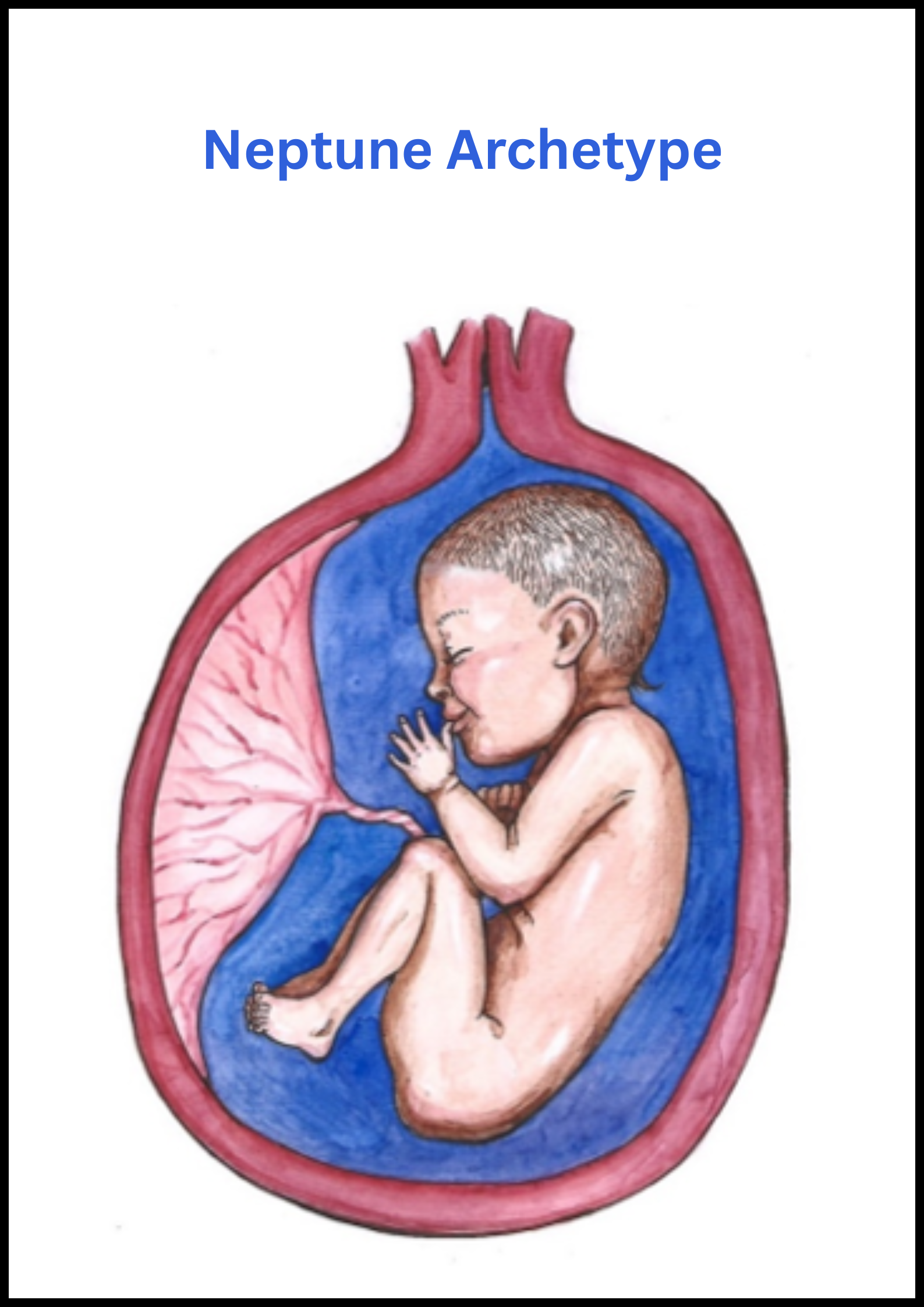
Image credit: Painting by Olena Provencher, From The Astrology of Love and Relationships by Renn Butler. Used with Permission from Renn Butler.
BPM 1 - neptune archetypal themes IN LIFE
BPM 1 has been correlated in Astrology with the Neptune Archetype by philosopher and cultural historian Richard Tarnas. There are many other archetypes in myth, philosophy and psychology which we could relate to the themes associated with BPM 1. For this article, I will focus on the planetary archetype Neptune in relation to BPM 1. Neptune pertains to archetypes related to primordial water, the great ocean goddesses and gods, the watery realms of our being, and the memory we carry of being bathed in the oceanic waters of the womb. In Greek myth, Neptune is the Olympian God Poisedon who presides over the sea. Neptune relates to the human souls capacity for imagination, dreaming, visions and inspirations, poetic expression, reverie and reflection, unitive experiences, blissful experiences, spiritual experiences, compassion for the destitute and vulnerable, numinous experiences, longing and the possibility of returning to ones spiritual essence, to one’s spiritual home. The journey with Neptune can be a long one. Belonging, feeling safe, feeling welcome to be alive, and at peace with one’s existence are themes which surface with BPM1. Neptune can also present in more problematic or challenging ways, where we may experience a preoccupation with fantasy, illusions, delusions, idealisations, psychologically undifferentiation of the self, and diffuse boundaries in relationship with others. We may be drawn towards utopian visions which can be both inspiring and creative, as well as disheartening when we realise our visions fall short of the reality of the limitations of our life circumstances.
We often experience Neptunian themes in our life when we encounter astrological transits to our natal Neptune (e.g. around midlife when transiting Neptune squares our natal Neptune, or when transiting planets conjunct our natal Neptune).
“Only the healing of human imagination can allow us to heal the collective water supply that we all share, and vice versa, only the healing of water will allow us to heal our human imagination”
BPM 1 - Experiences of Time
When we are in a Neptunian state of consciousness, there is generally a slipping away of any interest or concern for structured linear time – clocktime. We can have experiences of time which feel like ‘dream-time’, like ‘eternal time’, or the present feels transcendent.
BPM 1 - Psychological Processes
BPM 1 relates to our symbiotic experience in our mother’s womb and what this experience was like for us. Did we feel safe, related to, and welcomed in our existence? With modern advances in neuroscience, research is discovering the importance of the babies right hemisphere development in the womb, and how this is the foundation of a child’s attachment patterning with the mother which continues to be shaped into first 2-3 years of life, and endures into adulthood (Schore, 2019). If our individual growth during adulthood becomes truncated in BPM 1 process due to missing experiences of safety and relationally secure attachment in our early years, we may encounter difficulty in integrating the psychological developmental processes of the other BPM matrices - BPM 2, BPM 3 and BPM 4. We may experience psychological processes related to the desire to relive harmonious feelings of safety in the womb i.e. craving the lost womb, or to numb any memory of our womb experiences in which we felt unsafe or unloved. This can include psychological processes such as: autistic processes, psychotic processes, addictive processes, obsessive preoccupation with fantasy worlds or delusional processes. Addictive processes can take many forms. In terms of substance or medication use, we may seek out substances that tend to numb pain and induce more sedative or calm euphoric blissful states, for example narcotics may be used.
BPM 1 - Experience of Ecstasy
A particular type of ecstasy, known as ‘oceanic ecstasy’ has been associated with BPM1 (Grof, 1975). Oceanic ecstasy may occur in various ways, for example: spontaneously, through blissful unitive experiences in water or nature, via an inner alchemical process in the body merging essence with spirit, through meditation, through sexual union, during holotropic breathwork, or with euphoric inducing substances. Oceanic ecstasy can also be understood to encompass, more broadly, mystical or blissful states of consciousness which can occur spontaneously.
BPM1 - Dante’s Divine Comedy
In The Divine Comedy written by Dante Alighieri, a symbolic association may be drawn between BPM 1 and Paradiso.
““Well may you launch your vessel upon the deep sea.”
“It is love that moves the sun and other stars””
BPM 2 - ANTAGONISM WITH MOTHER
NO EXIT, CONTRACTIONS IN CLOSED UTERINE SYSTEM
The onset of labour begins the process of feeling immense pressure to escape the birth canal. The contractions and extreme forces of constriction and pressure are experienced as a vital threat to the self’s existence. The previous feelings of Primal Union with the Mother fade out of our awareness and we are catapulted into the underworld terrain – the archetypal experience of Saturn. Our mothers cervix is not yet open, and our movement is restricted, hence in our body and psyche we can have experiences of foreboding darkness, a ‘no exit’ situation, or impending death. During or just preceding this phase, we might have been subjected to the experience of an induction or cervical stretch and sweep to ‘bring on labour’, or a vaginal examination. We might have experienced the side effects of medications in our mothers system, either ingested, injected, inserted or inhaled. We may experience the atmosphere of panic from those in the birth space. We may feel engulfed in the emotions and pain our mother is experiencing.
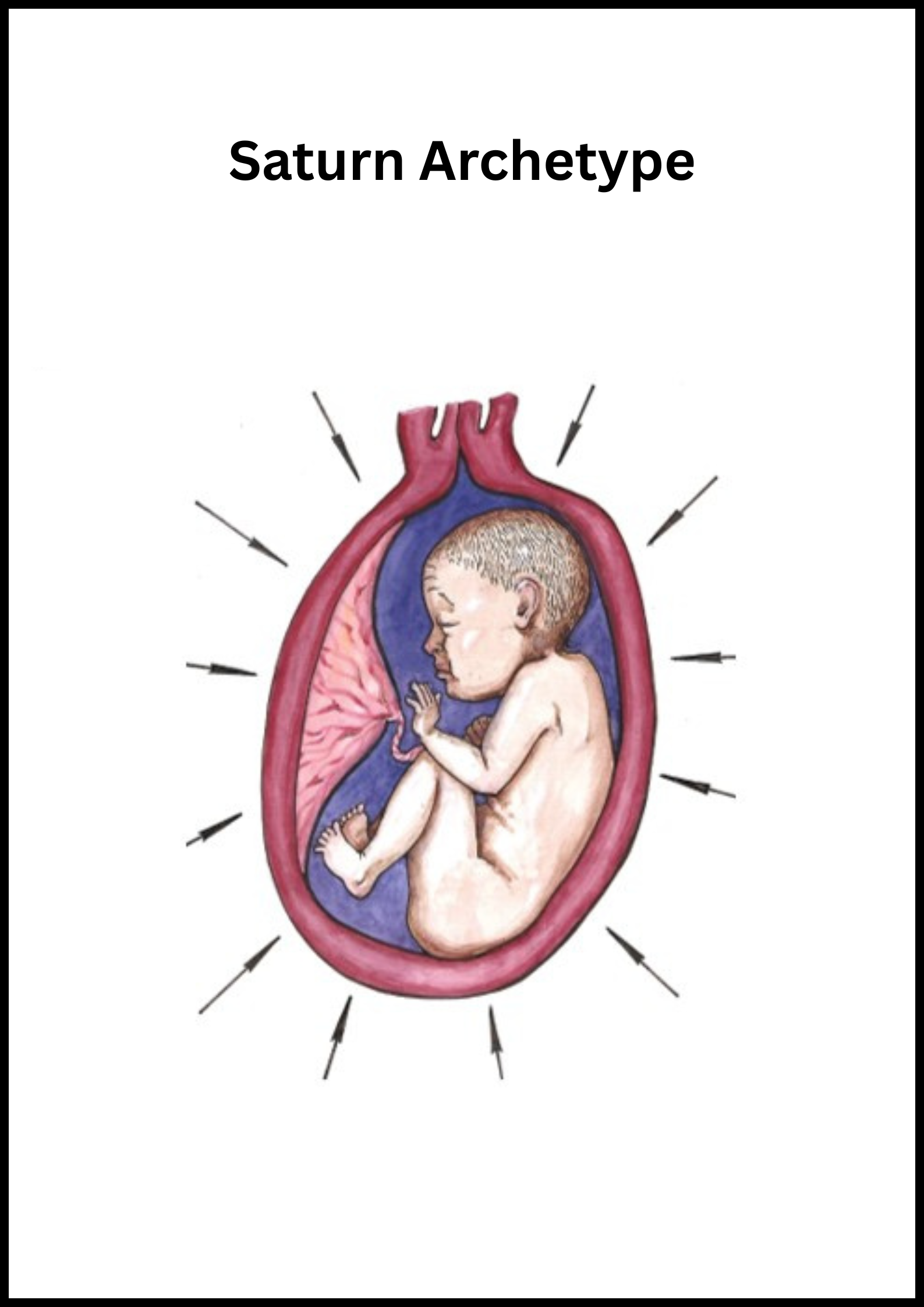
Image credit: Painting by Olena Provencher, From The Astrology of Love and Relationships by Renn Butler. Used with Permission from Renn Butler.
BPM 2 - SATURN ARCHETYPAL THEMES IN LIFE
BPM 2 has been correlated in Astrology with the Saturn Archetype by philosopher and cultural historian Richard Tarnas. There are many other archetypes in myth, philosophy and psychology which we could relate to the themes associated with BPM 2. For the purpose of this article we will focus on the planetary archetype Saturn in relation to BPM 2. Saturn is Chronus, who is known in Greek Myth for swallowing 5 of his 6 children: Vesta, Ceres, Juno, Pluto, and Neptune, while his 6th child Jupiter was secretly protected by his mother Rhea.
Saturn relates to many different archetypal themes and experiences in life including: our inner authority, the archetypal father, authority figures, governments, police, organisations which shape us for better or worse, the status quo, structure and systems, solitude and seclusion, sickness and chronic pain, death and dying, feeling trapped, pressured or oppressed, feeling decisions are fated and necessary, feeling trapped, despair, abyss upon abyss, dread, guilt, grief, melancholy, difficultly feeling pleasure in life and sexual pleasure in the body, cut off from eros, impotence and infertility.
Saturn makes us face the boundaries, limitations, and difficult truths of our life on earth. Saturn provides a container for our body of flesh in which we develop and mature over time. In his relationship to death and death of the ego, Saturn is often described as the ‘dweller on the threshold’ (Oken, 2008). Symbolically this phrase also has meaning in terms of his position in the solar system, where he resides like a gatekeeper between his son Jupiter and the outer transpersonal planets: Uranus, Neptune, Pluto.
We often experience Saturn themes more strongly in our life as we encounter important Saturn transits, namely around 28 - 30 years at our Saturn return and again around 60 and 90 yrs. Every 7 - 8 years we experience a Saturn square to our natal Saturn, which creates a markers of our developmental growth. We also experience Saturn themes quite strongly whenever Saturn touches planets in our chart, through conjunction, square, opposition or trine.
“Saturn is, in Nietzsche’s phrase, the “spirit of gravity”, both heavy and dark”
BPM 2 - Experiences of Time
Chronus is the Greek name for Saturn, the Titan God. Chronus is the personification of chronological time, that is clock-time or lock-step time. We can feel controlled and trapped by this experience of time, we can also feel a sense of satisfaction when we are able to constructively work within the limits of this time. People who have experienced medical induction as babies, interestingly may experience a complexed relationship to Chronus time, with feelings of anxiety around being late, being controlled, or pressured by clock-time.
BPM 2 - PSYCHOLOGICAL PROCESSES
Depressive processes are a common psychological process associated with BPM 2 seen in modern day. Processes of intense grief, despair, guilt, no will to live, paralysing fear, or feeling psychologically tortured or trapped are associated with BPM 2. Psychotic processes can also be associated with BPM 2, where there is a withdrawal from life and the world feels meaningless. Other defensive processses associated with BPM 2 can include suppression or repression. Swallowing ones inner child or swallowing ones emotions to avoid feeling pain or joy. Addictive processes such us: an addiction to work, dependency in relationships, or dependency on substances like alcohol and narcotics are associated with BPM 2.
BPM 2 - no Experience of Ecstasy?
BPM 2 when active in the psyche and body can be associated with repression of life force, of eros, and restriction to it’s flowing movement in the body. Hence BPM 2 is not typically associated with states of ecstasy. However, many mystics have described near death like experiences or paralysis type experiences, which elicit a kind of ecstatic rapture in the heart. It is possible this kind of ecstasy has an origin in BPM 2 experiences, but also moves through into other BPM’s due to its connection to death, transcendence and spirit.
BPM 2 - Dante’s Divine Comedy
In The Divine Comedy written by Dante Alighieri, a symbolic association may be drawn between BPM 2 and Inferno - Hell.
“
“Hope not ever to see Heaven. I have come to lead you to the
other shore; into eternal darkness; into fire and into ice.”
―
“Do not be afraid; our fate
Cannot be taken from us; it is a gift.” ”
BPM 3 - SYNERGISM WITH MOTHER
PROPULSION THROUGH THE BIRTH CANAL, THE DEATH-REBIRTH STRUGGLE
In this phase of labour, the mother’s cervix is opening more to allow for the baby to emerge. Here experiences of liminality can deepen. We can begin to feel the dynamic forces erupting and a surge of energy encouraging us through the birth canal, freeing us from the previous feeling of being trapped. The forces are immense, we can feel suffocation, strangulation, crushing pressures, and a profound struggle for survival. It can feel like death, but we can also feel the powerful urge to be free. This phase of labour often encompasses the experience of ‘transition’, as we meet the dynamic death-rebirth struggle. In babies born in the breech vaginal presentation, this phase is externally clearly visible as baby emerges from the cervix with their body suspended in the exterior world before their head finally emerges. Sadly, this phase is commonly associated with harm, obstetric violence and trauma to baby and mama in the form of unconsented vaginal examinations, routine episiotomy, cutting of the womb, and forceful removal of the baby from the vagina/womb during cesarean, or births where forceps, vacumm extraction, or hands are used.
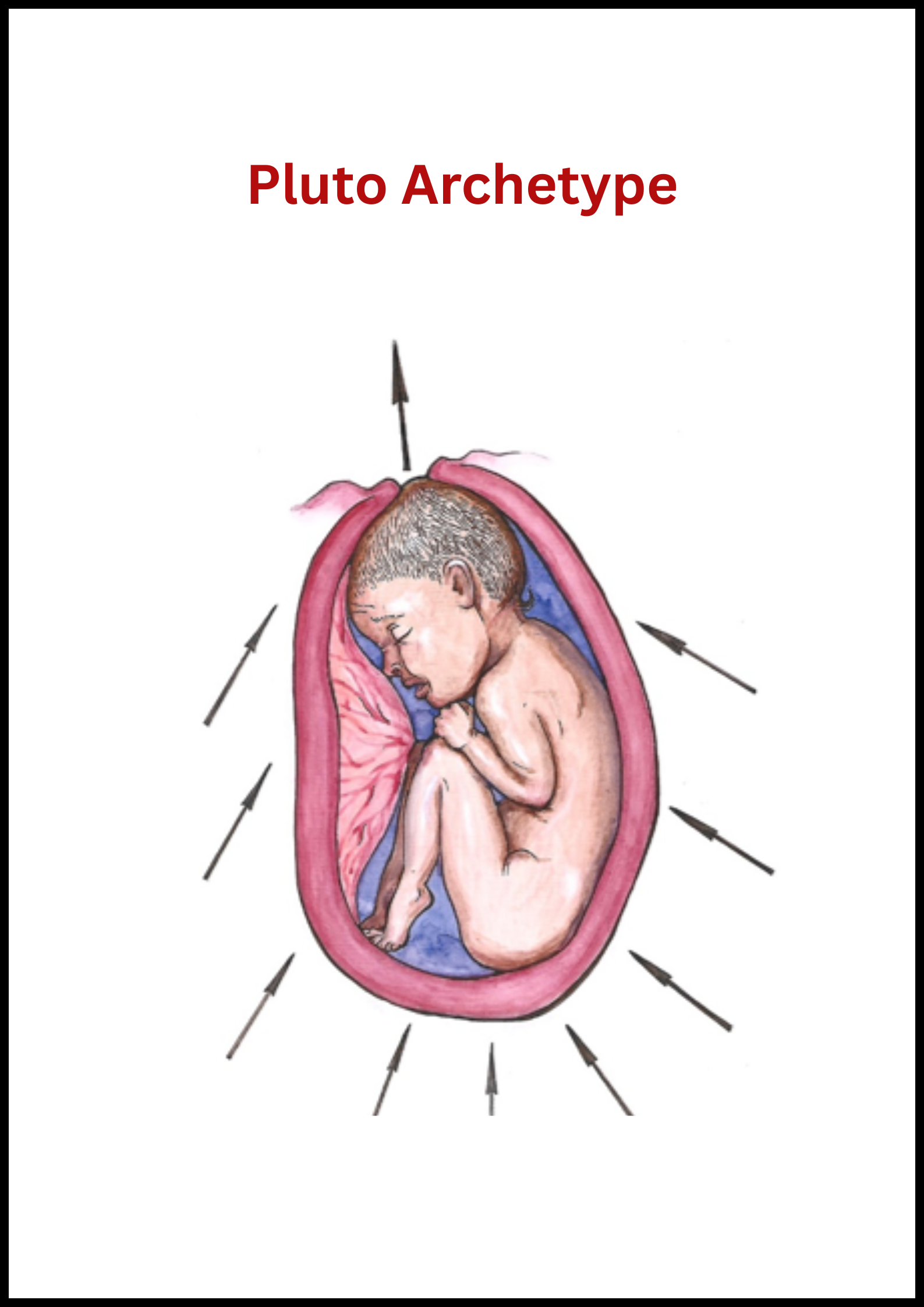
Image credit: Painting by Olena Provencher, From The Astrology of Love and Relationships by Renn Butler. Used with Permission from Renn Butler.
BPM 3 - pluto archetypal themes IN LIFE
BPM 3 has been correlated in Astrology with the Pluto Archetype by philosopher and cultural historian Richard Tarnas. There are many other archetypes in myth, philosophy and psychology which we could relate to the themes associated with BPM 3. For this article we will focus on the planetary archetype Pluto in relation to BPM 3.
Pluto in Greek myth is Hades, the God who presided over the Underworld. Pluto is known as the “unseen one”, as he did not dwell in the upper world. His relationship to the upper-world was one of violence and violation (e.g. the Abduction of Persephone). Pluto archetypal themes relate to experiences in which are unconscious or hidden. We can be confronted with the darkness within ourselves, in others, and in humanity. An encounter with power struggles is common, feeling either powerful or disempowered. Challenging feelings such as shame, repulsion, disgust, the urge to purge, compulsions, greed, lust, jealousy, violence and feeling violated, may arise when we are working with the archetype of Pluto. We can have experiences in life where we have been manipulated, betrayed, coerced, lied to, abused in any way - physically, sexually, psychologically.
In order to feel the power of Pluto moving through us and to work through challenging feelings, life may ask us to feel the fear, let go of attachments, to purge and transform, and allow aspects of our self to ‘die’.
“Pluto is where we get cooked”
“Pluto refers to the hidden wealth or the riches of the invisible”
BPM 3 - EXPERIENCEs OF TIME
The underworld domain of Pluto in myth was said to be a place in which time did not exist. That said, liminal experiences during BPM 3 may allow for the perception of ‘clock-time’ to stretch and shorten. We can feel the experience of chaos and destruction as primordial, ancient and ever present in the weave of creation which we are held in. We might feel the cyclical nature of soul time or connect to past lives within our soul when we are encountering BPM 3 in our life.
BPM 3 - PSYCHOLOGICAL PROCESSES
BMP 3 is psychologically associated with feelings of vital threat, fear, rage, feelings of power and dis-empowerment. Sadistic processes and masochistic processes, and obsessive-compulsive processes are related to BPM 3 (Grof, 1975). Agitated depression or extreme anxiety as also been been related to BPM 3 (Grof, 1975). Addictions related to substances, processes or things which seek to amplify ones feelings of power can be present (e.g. sex addictions, pornography addictions, or addictions related to greed - money, wealth, resources, power).
BPM 3 - EXPERIENCE OF ECSTASY
The ecstasy experienced in BPM 3 has been described by Stanislav Grof as ‘volcanic ecstasy’, a kind of wild ecstasy of cosmic or titanic force (Grof, 1975). BPM 3 is also associated, more broadly with intense power and expression of sexual energy.
BPM 3 - DANTE’S DIVINE COMEDY
In The Divine Comedy written by Dante Alighieri, a symbolic association may be drawn between BPM 3 and Purgatory.
““Here may indeed be torment, but not death.”
“This mountain is so formed that it is always wearisome when one begins the ascent, but becomes easier the higher one climbs.” ”
BPM 4 - SEPARATION WITH MOTHER
TERMINATION OF SYmBIOTIC UNION, REBIRTH AND INDIVIDUATION
This is the final stage of birth, in which baby emerges. In a natural physiological birth in which there is no intervention and baby emerges on their own, there are typical feelings of elation, relief and relaxation in the body as the intense struggle through the birth canal has culminated. It is here that we take our first breath on our own and release emotion from our lungs. We have arrived on earth, and begin the journey of a new relationship with our mother and family. This phase encompasses the birthing of our placenta. Ideally the separation from our placenta is gradual, to allow for a gentle transition into life on earth. If birth has occurred physiologically without intervention, there might be an instinctual activation of maternal skin-skin connection, protection and sensitive attunement to baby. This creates the necessary attachment the baby needs to develop a safe relationship of love and trust. If this occurs, we might experience our arrival as safe and welcoming, an experience that feels like ‘heaven on earth’. However, this does not always happen, so the experience for baby entering the world can be one of trauma and shock, rupture, dissociation, separation from mother, harm and violence to the baby, or in some instances death of mother and/or baby.
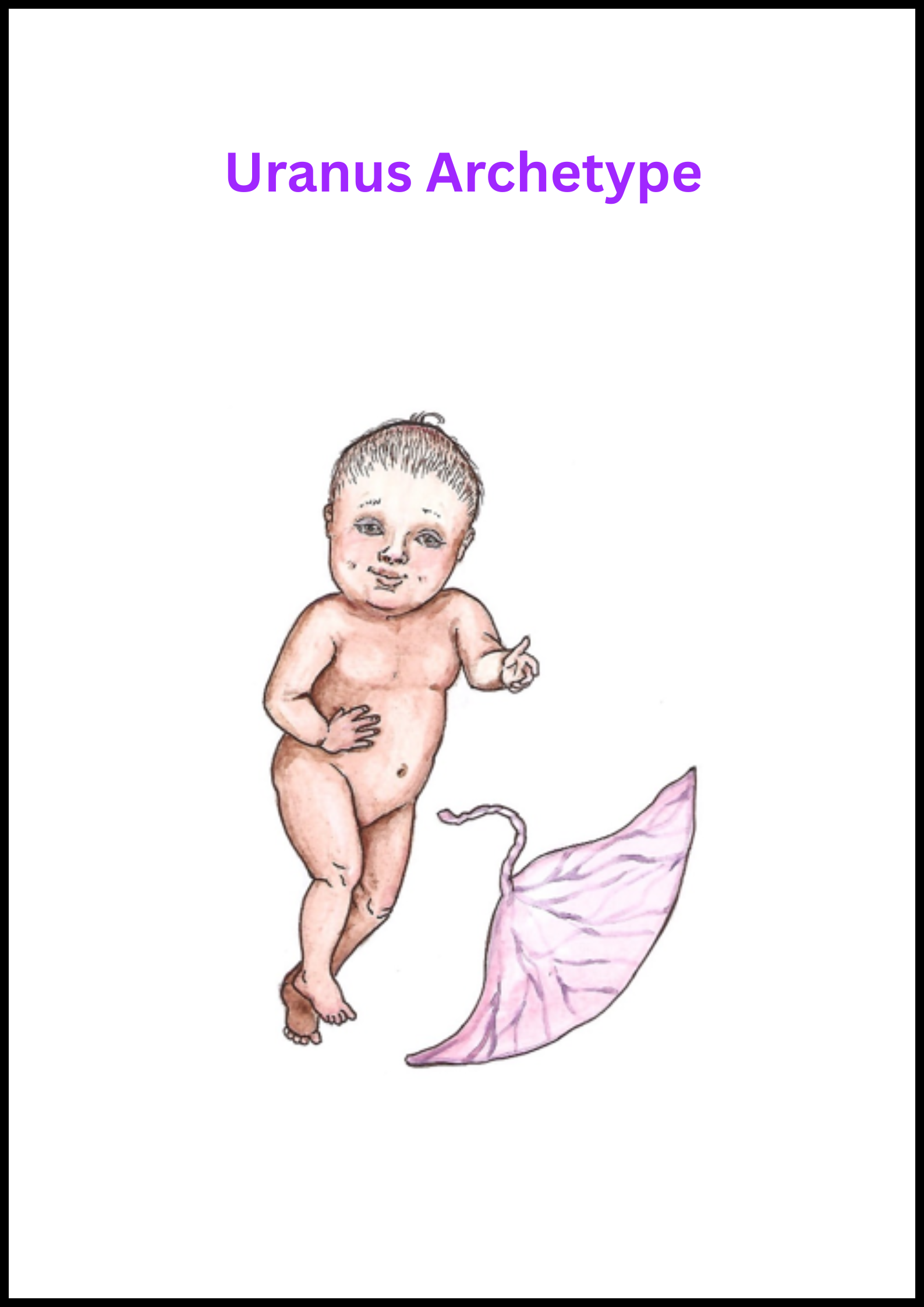
Image credit: Painting by Olena Provencher, From The Astrology of Love and Relationships by Renn Butler. Used with Permission from Renn Butler.
BPM 4 - uranus archetypal themes IN LIFE
Uranus in Greek myth is Ouranos, the “star spangled heaven”, the sky father, the oracular voice of heaven. His lover was Gaia, and they birthed a diverse and numerous array of children. Uranus was castrated by his son, Saturn. The mythology of Uranus and Gaia gives us information about their nature in our life. The separation of Gaia and Uranus causes much pain for created beings.
Uranus relates to the following qualities and experiences in life: uniqueness and individuality, diversity, unity in diversity, creative expression, innovation, freedom and liberation, rebellion and destruction of what has been created, rebirth, dissatisfaction with status quo.
“Uranus is the part of us that knows that the only form of communication is equal, direct, straight across. People could be wealthier, poorer, younger, but the only electrical form of connection is direct and straight across.
”
BPM 4 - EXPERIENCES OF TIME
BPM 4 and Uranus is associated with the Greek time known as kairos - ‘just the right time’. The time which feels auspicious, fortuitous, or as the saying goes ‘in the nick of time’. The quality of kairos time is in contrast to chronos time. Kairos time can feel more subjective, unique, sudden, abrupt, rupturing, or shocking.
BPM 4 - PSYCHOLOGICAL PROCESSES
Uranus and BMP 4 are related to the process of individuation, coined by Carl Jung. This process can entail a reliving of birth, being born anew, actualising our creative potential or unique soul gifts. What is often being birthed in this process is a new heart, which desires to unite heaven and earth, a heart which has the capacity to love oneself, humanity, and all of creation with openness and sensitivity. However, when we have not fully resolved the memories of BPM 1, 2, 3 there can be an impulsivity towards experiencing the themes and states of consciousness of BPM 4. There can be a preoccupation with psychological themes of destruction and recreation. Our creative impulse or individual expression may move through us and we may also have difficulty bringing it into form, the realitities of our form life, or feeling satisfaction with what we have created. BPM 4 themes in life can present with manic states, or delusional psychotic processes in which we may identify with archetypal, God-like, or heroic figures (e.g. Ra - the Egyptian Sun God, Christ, prophets, heroes e.t.c). Like Icarus who flies to close to the sun and ends up drowning in the sea, we may become inflated and loose touch with our heart, our humility, and the ground beneath us.
BPM 4 - EXPERIENCE OF ECSTASY
BPM 4 experience of ecstasy can be associated with a quality of feeling reborn, an ecstatic feeling of being alive, heart opened. It may also be toned by electrical sensations, manic states which feel exciting, enthralling, and destabilising.
BPM 4 - DANTE’S DIVINE COMEDY
Within Dantes Divine Comedy there are three main realms on Dante’s journey: Hell - Inferno, Purgatory - Purgatorio, and Paradise - Paradiso. When we have journeyed through the BPM 1, 2, 3 realms in our psyche and begun to process the loss of our womb life, our birth and early life trauma, naturally a process of integration within the psyche begins to takes shape. We are more open to understanding ourselves as a complex being and accepting the various archetypal forces which influence us in the course of our life. So, BMP 4 it seems is primarily about the experience of integrating our arrival on earth, and the difficult process of illuminating our soul body with our spirit. Through this process we may indeed glimpse Paradise.
Note to the reader: The information in this article is for educational purposes, to provide discourse for humanity to reflect on the experience of childbirth. The information in this article does not serve as professional or medical advice. Any errors are the author’s.
Article written by: Rose Skerten
REFERENCES
Butler R. The Astrology of Love and Relationships. 2022.
Caroline C. Making the Gods Work For You. Harmony, 1998.
Grof S and Grof C. Holotropic Breathwork: A New Approach to Self-Exploration and Therapy. Second Edition. Albany: State University of New York Press, 2023
Grof S, and Halifax-Grof J. Realms of the Human Unconscious: Observations from LSD Research. London: Souvenir Press, 1975
Hillman J. The Dream and The Underworld. New York, HarperCollins Publishers, 1979
Oken A. Soul-Centered Astrology: A Key to Your Expanding Self. Ibis Press, 2008
Reed R. Reclaiming Childbirth as a Rite of Passage: Weaving Ancient Wisdom with Modern Knowledge. Word Witch: 2021
Schore A. Right Brain Psychotherapy. New York, W.W. Norton & Company, 2019
Tarnas R. Cosmos and Psyche: Intimations of a New World View. London: Penguin Group, 2006